Tempest

Silas winced as more rain lashed at his eyes after he’d dared a glance at the storm around them. It had come upon them so suddenly in the night, only the relentless and violent tossing of the ship could adequately dispel the hope that it was a simple nightmare. He heard his fellow sailors screaming on the deck far below him, and above the howling winds and gutturally roaring waves, his ears caught their awe-struck cries. Silas chanced a look down, and what he saw drove almost all the rest of the world away. In the wine-dark waters churned an aurora of brilliant colors…

A ley line.

Massive ribbons of green and streaks of violet cut swathes of mercurial silver and indigo against the abyssal darkness of the sea at night. Within those colors sparkled crackling stars, like embers of a cold cosmic fire that ebbed and flowed with Thalassa’s own pulse. The immense strength of the storm swelled, pulling up a twisting wall of water. The cyclone gripped the ship, lifting it from the ocean’s seat. It drew the mystical colors up around them as a web, surrounding the ship and its sailors in it as though swaddling a babe. Seamen screamed and planks of the deck were ripped into watery oblivion.

Alone in the crow’s nest, he felt his pruned, aching fingers gripping the wood, desperate for any purchase and bleeding into the grain. He did not want to die. He could not. He had a need to return home so desperate and primal but to only be the gods’ gift to mortals. At last, he dared a glance at the sky. Primal, chaotic pressure swelled, and upon being noticed, it loosed. Alabaster lightning cracked from pregnant clouds, reflected in Silas’s eyes.

And it struck him.

He felt it in a single, phenomenal moment stretched across eternity. Within it, his life became a story indivisibly told. He thought of home, of white gulls against blue sky and the sandy fronts of Sanplona. His mother’s laugh, the warmth of her breast, and the months of cold pain following her death, all silently remembered in a fractured second. The sickly desperation of life alone, the relief in being found by his mentor, Brunah. The fulfillment in his hands, holding coins he’d earned with his own sweat, then by his first trade. But overshadowing it all were his wife’s eyes and his daughter’s face, standing over the memories like monuments.

Agony unlike anything he’d ever mortally known burned every fiber of his body, but not alone. Golden joy. Bitter and resentful scarlet. Ever-present lavender wanderlust. The violet of unfulfilled ambition. Sickly green anxieties and worries. Love’s warm magenta. They were all felt in an instant, and then, in that same moment, he was scattered, spread across the sky like paint on an artist’s palette.

World War Squirrel: Air Assault

“Command, this is Acorn One. Command, come in, do you read? Over.”
[Ack! I’m hit! Oh God!]

“Copy that Acorn One, The Nest is reading you loud and clear. Over.”

[It’s coming by again! Get down!]
“We’re getting hammered down here, Command. Requesting immediate air support, now! Over!”

“Roger that Acorn One. Request granted. Sending some Gliders your way. Over.”

*

“Sugar Squad, do you copy? Over.”

“Copy, Command. Sugar One responding. Over.”

“Got a request for a fly-by. Sending you the coordinates now. Over.”

“Received, Command. Sugar Squad, preparing to launch. Over.”

*

“Got that bombing run on the way, Acorn One. Sit tight, boys. Over.”

[Sir! Spreckle’s been hit!]
[Aaugh! So…soggy… Tell my mate I love her…]
“Roger that, Command. You’re really saving our nuts on this one.”

*

“Sugar One to Sugar Two. Come in, Sugar Two.”

“Sugar Two reporting.”

“Let’s get an open channel up here.”

“Done. Air’s yours, Sugar One.”

“Good. Gliders! Report in.”

“This is Sugar Three, reporting.”

“Sugar Four, reporting in.”

“Sugar Five here.”

“How’s that tail wind, Sugar Five?”

“Steady and ready to drop the yolks on these folks, Captain.”

“That’s what I like to hear, Corporal. Gliders! V-formation! Our target’s the giant at the smokestack.”

“Let’s get these assholes.”

“Hoorah!”

*

“Ugh, Christ!”

“What’s the matter, honey?”

“I think some squirrels just threw bird eggs at me.”

“I told you, it agitates them when you turn the sprinklers on. I think it hits their nest or something.”

“Ew! These eggs are rotten!”

“I keep reminding you to adjust the sprinkler head.”

“Dammit, some of it got on the grill, too.”

“How about we just finish up the burgers inside?”

“Ugh, fine.”

*

“Confirmed hit, Command. Dead on target. The giants are turnin’ tail.”

“Roger that, Sugar Squad. Great job out there today, boys. Come on home.”

Night of the Hag

Doste peered anxiously out the window. The moon was high, and there were a scant few clouds to hide its light. There was no one about at this time of night, but he remained nervous all the same. He drummed his fingers on the windowsill.

“Is this truly necessary?” he asked over his shoulder. His wife, Brynn, sat by the fireplace with their guest, and his eyes focused on their reflection in the glass. “We could think this over another night.”

The cloaked figure sat hunched opposite Brynn, poring over items in a deep wicker basket, and paused, silently looking first to Doste then to his wife.

“We have thought on this,” said Brynn, her voice soothing and warm. “We have thought and spoken and prayed, but this will be our chance.”

Doste felt himself frown slightly and a breath hissed from his nostrils, but he didn’t offer further protest. He joined them by the fire, and his gaze fell to the cloaked figure who had begun arranging items from the basket onto a small, whittled tray and grinding them with a mortar and pestle. Some of the reagents he recognized – whiteleaf powder, blackroot stems, Kingfoil moss – but some of the others being ground made his stomach uneasy.

“Yes, well,” he muttered, “I had imagined the help of a medicine woman in more of a…traditional sense.”

The figure cackled, and what little light from the fire reached into her hood briefly showed a face with unsettling features. “What I bring you,” laughed the hag, “is stronger than any medicine or faith you will find.” There was the smell of swamp water when she spoke, and her voice cracked against the ear like broken branches. She mixed the last of her components and brushed these into a separate bowl of liquid, viscous as blood.

Doste looked to his wife, but Brynn met his eyes easily with a smile, undisturbed by the creature’s presence. Her warmth never ceased, and he took such comfort in that. He allowed himself a deep breath, and together they waited for the hag to finish her concoction. When she had, she set the bowl between them and reached out with a gnarled hand, palm up.

“My payment,” she said simply.

“Oh, of course,” said Brynn, almost embarrassed. She reached into the folds of her dress and came away with a folded piece of cloth, which she handed to the hag. The hag looked it over quickly by the light of the fire and, seemingly content, stowed it within her cloak. Doste wore his confusion on his face, but Brynn discreetly shook her head at him.

“Place it beneath your bed, leaving it undisturbed for one week,” instructed the hag. “After your next bleeding, have your husband take you. Then, you will bring the bowl into the wilderness to the north and empty its contents onto the roots of an oak which bears a scar in its bark. When this is done, well…” Though her face was hidden in the darkness of her hood, the two could hear lips sliding back over wet teeth in the way of a grin. “Enjoy motherhood,” she concluded.

Brynn nodded solemnly, though she softly quaked with an inner excitement. She searched her thoughts for a few moments, struggling for words. “Thank you,” she said finally, the start of tears shimmering in her eyes.

They exchanged nods, the hag collected her things, and had opened the door when Doste stood.

“What if it doesn’t work?” he asked.

She paused in the doorway, the quiet howl of wind behind her, and she turned to face him. Still behind the darkness of her hood, he could feel her eyes on him. She gently cackled. “Then I’d suggest you visit an herbalist, Doste,” she laughed. “Because the problem then would lie not with my aid nor your wife’s womb.”

In the time it took for his cheeks to flush and for him to blink, the doorway was empty and the two were left alone, the hag’s laughter echoing hauntingly on the nighttime breeze. Doste turned to Brynn.

“What did you give her?” he asked.

“All she wanted was a poem on something of my mother’s,” she said. “So, I wrote her an old nursery rhyme I remembered from when I was young onto a piece of her wedding gown.” Brynn shrugged. “Cunning women are strange. But what’s more,” she strode over to her husband and embraced him, “is that we’ll soon have a family, Doste.”

END

This was another character origin I wrote up for someone’s D&D campaign. The first half of it, at least. It goes on to be for a warlock who’s part hag, essentially, but I never finished that bit (gave the notes to him to complete…I think. It was a few years ago.), so the first half is more neatly wrapped up than I otherwise left it.

Anyhoo, more stuff on the way. Hope your days are treating you well. 🙂

Ardan Brokenfoot (& news)

The foothills of the Nettiri Mountains are silent, eternal, and still, but for a howling wind. A roll of thunder rumbles its way across the moonless sky, and the clouds, pregnant with the coming rain, begin to loose their storm on the earth below.

“Aaaauuungh!” Yasha screams. Her breathing is harried, and hair clings to her face heavy with sweat. A woman beside her, Ritu, clasps one hand tightly with her own, and with the other holds Yasha’s face by her chin.

“Shh,” she soothes, “you are strong. Like earth- like the mountain, you are strong.” She moves the hair from Yasha’s eyes. “Now, again. Push. He is almost here.”

“I can’t.”

“You will.”

“I can’t,” she screams again, agony drawing out the word. The whisper of the hut’s deerskin curtain breaks the steadily drumming rain for a moment, revealing a mountainous man in the entrance. The tattoos on his bare chest glisten against the modest firelight within the hut. He huffs out a single excited breath.

“Has he come?” he asks.

“Soon,” says Ritu. “Come, hold her hand. She needs you now.”

The wind gains and hours pass, the screams of childbirth bleed into the howling of the storm outside. Then, of a sudden, the tempest dies and the cry of a newborn boy takes its place. His father, Korg, holds him, the pride clear on his face, but the expression soon sours.

“His foot,” he rumbles. The goliath holds the tender infant gently, the aberrant shrunken foot held aloft on two fingers, displayed like a withered leaf on a healthy vine. “What is wrong with his foot?”

Ritu smiles and shrugs a shoulder. “What is wrong with his foot?”

“How will he run?”

She brushes aside his long hair, revealing half an ear with a large bite mark. “You can still listen.” She smiles again. “At times.”

Korg barks a short laugh, which leaves behind fierce grin. He turns to the boy’s mother and kneels. “What do we call him?”

Yasha beholds her son for a long moment.

“Ardhan,” she whispers at last. “After your grandfather.” She holds his leg and beams brightly. “Ardhan Brokenfoot. A name to give him strength.” She then gestures weakly for a box near her bedside, and Ritu nods. The old woman brings the wooden box, and Yasha draws from it a talisman on an invisibly thin silver chain. The talisman itself is a chip of dark stone, but as the light catches its surface, faintly iridescent markings of an unknown script shine against it. The wind outside begins to swell, and Yasha holds the boy’s forehead to her own before slipping the necklace over his head. “You will have a good life, Ardhan. This will help you find it.”

*

As Ardhan grew, he would come to know the land as well as the corners of his own mind. It was harder for him than most, but that adversity blossomed into a strength few others shared. Nestled within the mountain walls of the Nettiri, it was a land of slate, pine, and storms, but also of voices that came in many shapes. The winds had their song, the village elders had their chants, and even the great pines would drum the air with their crackling boughs. But Ardhan would know more than just these.

In his years walking the mountain forests, he would see figures cloaked in dark mists, eyes dimly aglow beneath ethereal hoods. They never frightened Ardhan, and where they walked more songs would follow. The songs were like a humming melody he could feel in his bones more than he could hear it aloud. He would walk the woods with them, playfully seek them out, and where they ventured he would find strange things like the talisman he’d been given as a baby. He would collect these relics in a light sack and return to show them to his mother and father, though they would pay him no mind.

It was on another day like this that he returned to the village and found a group of strangers speaking to the tribe’s eldest, Grontu. The strangers wore dark mantles and hoods that obscured their faces. When they spoke their hushed whispers to Elder Grontu, his lip curled in disgust. Ardhan didn’t hear very much from his chosen hiding place, but what he did spoke of ancient relics and mystical powers. He held the bag at his side a little more tightly against his body.

“You ask of things you only pretend to know,” Grontu spat angrily. “Heed my warning and depart, or else I-”

Ardhan was pulled suddenly off his feet by his hair, and he landed on his bottom in a small cloud of dust. His mother loomed over him. “What do you think you are doing?” she whispered harshly. “Their words are not for one so small.” Yasha regarded him angrily for a long moment, then held a breath and her face softened. “Head home. Dinner is soon. Go,” she said, giving him a light push. His mother’s eyes were warm, but she was not to be tested on this. So, embarrassed and wiping away tears, the young boy nodded and ran off.

He rounded the last turn and was at the opening to his home when a gentle tremor went through his body. He stopped short, but soon recognized the resonant hum in his bones. Ardhan glanced about and soon saw them – dim, crystal blue eyes glinting at him from the shadows of distant pines. They beckoned him, pulling the at the strings of his spirit with a wordless call as undeniable as gravity. Again he looked about, thought of his mother’s warning, but defiantly tightened the strap of his bag and set off for the woods.

*

Hours later, the sun hung in the sky, threatening to dip below the horizon and painting the sky in warm hues. The chill wind rushed over him as Ardhan made his way back home to his village. This was not the first time playing with the mountain spirits had kept him from home so long, but this time it was sure to enrage his mother after he’d disregarded her intructions. Though as he came close to home, a feeling of dread settled in his stomach like a heavy stone. It was the dry season, but a mist hung in the air and climbed lazily from the ground like smoke.

There was no one here.

He heard voices, but they were quiet, muffled, like he was hearing them through a thick cloth. Ardhan followed the voices in circles all about the village, but found no one. A chill gripped his heart as he realized something. It was slow to come, and it wasn’t true for all of them, but the truth remained: the voices were saying things he’d heard before.

“Their words are not for one so small,” said one, the voice of his mother.

“Come. Hold her hand. She needs you now,” said another, the cunning woman Ritu.

“You ask of things you only pretend to know,” came yet another, Elder Grontu.

“He has come?” the proud voice of his father, Korg.

Ardhan stood there in the center of his village for minutes, his home now reduced to a hollow land of ghosts and echoes.

Those next hours and what would be the next several years passed over Ardhan like a high wind, staining his memories only as blurred flashes. He remembered seeing the crystal-eyed mountain spirits and running with them to the woods where he found sleep in the hollow of an ancient pine. He remembered a woman with a gentle face and raven hair looking down at him as he woke. She fed him, and gave him hope, a home, and purpose. He didn’t see himself as he grew into a strong, capable Goliath warrior beside her, but he remembered their travels. They traversed the wilds and great cities alike, both harsh lands with terrible beasts and civilized bastions with towering spires were their home.

And through it all, the voices of the mountain spirits of the Nettiri were silent.

*

“Okay,” said Jaya, tossing a stormy, raven-black lock of hair away from her face. “I’m going inside to inspect the merchandise for our client. This one’s gonna be high profile in the long run, so I want you out here to make sure it can get off on the right foot.” She waited a moment, then snapped her fingers. “Hey, Ardhan. You listening?”

The pair stood in front of a parted curtain obscuring an entryway in a shadowy alley. Between them filed a short line of hunched figures carrying unmarked crates and nondescript sackloth bundles, and across the way on the corner of an intersection of the city’s dusty dirt roads was the colorful storefront of a toy maker. Baubles gleamed, clockwork animals jumped and spun round, and magical lights drew designs on the curved glass of the windows. Ardhan broke off in the middle of a chuckle.

“Mm, yep. No problem, boss,” he said. “Nobody’s getting in without the sign.”

She regarded him skeptically for a few moments, but settled a hand on his massive forearm and squeezed gently. “Good,” she said. “Things are going to be different after today. Stay sharp, big guy.” He reassured her by adjusting the grip on his saw-toothed greatsword and smiling, which she returned with a wink before disappearing behind the curtain.

Ardhan stood watch, and time passed, offering nothing of note. Then something happened which hadn’t in so long he had almost forgotten even the deepest memories of their being: a melody hummed through his bones. Here, he wondered, in the heart of a city so far away? He looked up and down the alleyway, and there at the end stood one of the figures of his childhood, cloaked in darkness and melded with the shadows and the stone. Ardhan regarded the spirit, and a torrent of memories – of his village, of the mountain pines of the Nettiri, the echoed voices of his mother and father – they all assailed his mind at once, and the craving for answers returned, as fierce and as strong as it had been that night.

He followed the spirit, and as he did, he felt almost like a boy again. His muscles forgot their aches, his skin lost its scars, and the weight on his heart he’d forgot was there lifted. He reached the end of the alley where the spirit had been, and saw it now across the populated thoroughfare of one of the city’s main bazaars. It was like one of the games they had used to play when he was a child, the games he’d taken shelter in when he was young. They had made him feel safe through times like…

Like the night his family was taken from him.

A familiar sense of foreboding and dread suddenly fell on him like a leaden sheet. He spun around to see a hunched figure in the distance, exiting the meeting place he’d been meant to guard. Ardhan broke into a sprint, and upon seeing him, the figure darted out of sight. “Jaya!” he called. “Jaya, get out of-”

The world went white.

A wave of force blew him back the way he’d come, sending him flying out of the alleyway altogether. The building which housed the business his friend and mentor Jaya had been overseeing exploded, erupting in gouts of emerald flame and streaks of alabaster lightning. Ardhan tumbled through two market stalls, and panic spread through the crowd. He looked up from the pile of splintered wood and broken pottery, and the last conscious sight he held was of the crystal-eyed mountain spirit standing in the flames of the ruined building, holding Ardhan’s gaze with its own.

Then darkness took him.

END

That was a D&D character origin story I was asked to write for a friend. I was flattered, if not outright honored, as this friend didn’t need help writing a good story in the least bit. He’s grown into a REALLY good DM and could have done better himself. Nonetheless, it was fun to put together.

And in case you missed it: There’s news! Had a couple of publications this summer, firstly over at Twenty-Two Twenty-Eight Magazine is my story “Just like Old Times”, and more recently is my Sci-Fi story “Software” with Third Flatiron’s Offshoots: Humanity Twigged anthology. Check ’em out, let me know what you think, and live well.

Oasis

Jeremy watched the birds circling overhead. Seeing the black dots dance in their circuit above him, dark wings flickering against the bright white-blue of the sky, it was sort of like a negative image of sparkles in his eyes, and the thought of that made him chuckle. His tongue prodded dryly at the back of his teeth. He was lightheaded. His heat-shrunken brain reminded him that dehydration caused things like that. He chuckled again.

This was bad.

His feet were hot, so he tucked them underneath himself as best he could, into what scant shade his car provided against the abusive sunlight. Looking out, he watched the heat waves ripple against the unending white of the salt flats.

“You really should have packed some water,” said a voice.

Jeremy turned his head limply in the direction of the sound. There was a man leaning against his trunk. He wore loose-fitting linens that billowed gently in the warm desert breeze, bangles about his wrists, and nothing on his feet. The man smiled softly at him.

“Jared Leto?” asked Jeremy. The man barked a full laugh, but shook his head. “Thank God.” Then, after a moment, he asked “Am I dying?”

“A little bit,” said the man, nodding. “For real though, no water? Nothing?”

It was Jeremy’s turn to shake his head, then, reaching up through the open driver-side window, withdrew a mostly full bottle of bourbon.

“Wow. Not much good that’s going to do you.” The man in white took a seat next to him. “How’d you get way out here?”

“Mid-life crisis,” Jeremy answered simply.

“Some people buy a motorcycle to cope with those, maybe dye their hair. Not you?”

“Nope. Divorced, then bought a car I can’t afford and took it somewhere I could drive it really fast without getting arrested.”

“Race track didn’t make sense for that?”

“I guess not. Always wanted to drive on the salt flats, loved the idea of the desert. Or, at least, I thought I did.” Jeremy eyed the bottle in his hands a moment before setting it down. “The desert sucks.”

“It’s not great,” the man agreed. A few minutes passed with them both watching the few, thin clouds in their struggle against dry air. “If you don’t mind me asking, what’re you running from?”

Jeremy fought the reflex to deny the question and say that he wasn’t running from anything, and instead actually thought about it. Because, of course, there was an easy answer. He was running away from an utterly crumbling life: failing marriage, dead dreams, the shame of those things now hanging over his social circles like a immense wet blanket. And while there was still truth to an answer like that, the longer he took to steep in thought over it, it didn’t feel like the complete truth.

“I don’t think,” he began at length, “that I am running from something.” The man in white watched him patiently, feeling that the rest of the answer was incoming. “No. I think…I think I’m running after something instead. It’s like a dream, maybe, but one that I’ve never had- or maybe, more like one I’ve had a thousand times. That, and I listen to too many hard rock highway songs.”

“The ‘us against the world’, ‘drive fast and die young love song’ type?”

Jeremy flashed a finger gun. “Bingo.” Despite himself, tears slowly began to well up in his eyes. “So, when I bought this stupid car, tore off the lot, and drove it out here as fast as it could go with the top down, it wasn’t supposed to be by myself. That’s never how the daydream went. It was supposed to be my wife and I, middle fingers up in the air, rock music, all the rest of it. Not, well, this.”

“Well,” sighed the man in white, “what are you going to do, now that you are here?”

“I could just…die. Lots of people have done it.” He looked at his warped reflection on the bourbon bottle. A hot breeze blew dust over Jeremy’s feet and speckled the brown glass, aging it in an instant. For a moment, he considered what it would look like to someone who found him out here, weeks, maybe years after he died. Skeletal, coated in dust, forgotten. What stories would that person come up with as to how he got here, or would they find it obvious? Since Not Jared Leto was clearly just a figment of his dried up imagination, it would be the bones of a single lonely and doomed idiot who drove out to the desert, broke down, and died.

“You could,” nodded Not Jared, “but I wouldn’t recommend it.”

“It would be easier. A lot easier.”

“Than what?”

“Going back.”

“‘Remember, if the time should come when you have to make a choice between what is right and what is easy, remember what happened to a boy who was good, and kind, and brave.'”

“Ghandi? Old Testament?”

Not Jared laughed. “No,” he said. “Albus Dumbledore.”

END

I wrote that up at work the other day on nothing more than a whim. I was listening to some rock music from my teens years, felt a scene coming on, and voila. It definitely feels a little unfinished, but I had nowhere else I cared to take it, but I imagine Jeremy made it home, apologized for something, and lived happily ever after.

Anyway, news! Had a couple of publications this summer, firstly over at Twenty-Two Twenty-Eight Magazine is my story “Just like Old Times”, and more recently is my Sci-Fi story “Software” with Third Flatiron’s Offshoots: Humanity Twigged anthology. Check ’em out, let me know what you think, and live well.

A Jack of All Trades Mindset

I enjoy a lot of hobbies, and sometimes that can feel a little like that means I’m not good at anything. I took up cooking recently because my wife and I were gifted a cast iron skillet that I fell in love with. I started by getting a couple of cookbooks, trying out different recipes, then going off-book and coming up with my own, now slightly-informed concoctions. And it’s been going well. I know more herbs and techniques now than ever before in my life, and I love the creative process of it all. Not everything I churn out is menu-worthy, but some stuff is.

And as with any activity, trade, or artform, there’s always more to learn, and there’s more going on under the hood than appears on the surface. That’s true when you learn anything, and it’s part of what can make everything fascinating. Once you realize everything’s that way – there’s a starting point, a process, progress, and development – anything new you try is at the same time more daunting and more accessible than it was at first glance.

It was that way with rock climbing and running, when I did those back in the day; I’m a big Magic: the Gathering player and it was that way learning the in’s and out’s of the game; same way, albeit simpler, for my recent backgammon obsession; similar to learning how to bend notes and operate your tongue playing the harmonica; and it was the same when learning how to shoot a bow back in the day, learning how to stand, how to use your shoulders and set your hips, how to release without plucking, how to breathe, etc.

Frankly, I’m kinda good at a number of things, because I’ve pursued them with interest. But the downside there is feeling like I also kinda suck at everything, since in each of those avenues mentioned above, there are loads of people who are better at them than me.

I’m better now at cooking than I was a few months ago, and it’s been real nice to impress friends and family with my newly acquired know-how, but next to any truly savvy cook, I’m a total chump. I’m much better than your average person walking the street at using a bow and arrow or playing Magic, but would be a slack-fingered halfwit on the line or at the table next to anyone who trains and/or goes to tournaments. I earned my first ever backgammon against a good friend the other week, but your average club member would probably use me to mop their floors.

But – and this is a big ol’ nice jiggly “but” – being the best at your hobbies shouldn’t be the point.

Kurt Vonnegut had a good story once about being sent a letter from a fan, and while I’m foggy on the details, I do remember the advice he had for said fan: Go home and write a poem. Make it the worst, most stupid and dumb-sounding poem that’s ever existed if you have to, then rip it up into tiny pieces and scatter them. The point isn’t in having the poem to show off, but in having written it. Art isn’t supposed to be done for a sale (funnily enough being said at that point by a profoundly successful professional author – an irony he himself points out). The whole point of art is to do it and enrich yourself by doing it. So write a shitty poem, sing a song that sucks, make a clay pot that’s ugly as sin – just do it, though.

I’ve raved before about how great a lesson the Pixar movie Inside Out had to give out, and up there next to it is the movie Soul. If you haven’t seen it yet, skip to the next paragraph, starting…now, but in essence the lesson of that movie is that a single-minded pursuit is the best way to miss out on life. The main character is so wrapped up in his romantic pursuit of being a jazz musician, he not only misses out on the joys of his daily life and he’s shocked to see the realities of that life don’t fit his ideal once he becomes one. It takes a cartoon cat to show him that life is about the small, loveable mundanities, the variety. No one slacks him for having a dream, it’s just that there’s more to life than that.

Now, there is a certain nobility to giving up a varied life experience in order to power-level one particular skill, to eschew other interests and pleasures in pursuit of mastery of one specialized thing. The star athlete that devotes every waking thought and action toward championship of their sport, the craftsman that locks themselves away in pursuit of perfection of their art, the businessperson that is single-mindedly focused on whatever they heck they’re doing – there is a certain degree of honor due to that lifestyle. But I’ve been stuck with the following quote ever since I came across it, spoken by Lazarus Long in “Time Enough for Love” by Robert Heinlein: “A human being should be able to change a diaper, plan an invasion, butcher a hog, conn a ship, design a building, write a sonnet, balance accounts, build a wall, set a bone, comfort the dying, take orders, give orders, cooperate, act alone, solve equations, analyze a new problem, pitch manure, program a computer, cook a tasty meal, fight efficiently, die gallantly. Specialization is for insects.”

So in conclusion, does a part of me lament not being the best at whatever I set myself to? Yes, a little bit. Does the rest of think that’s a pretty stupid thought? Absolutely. I think it’s kind of awesome to celebrate the talents, displays of skill, and ingenuity of our fellow peoples. We, individually, can’t do everything, we never will, and it’s a load off to realize that. Should we strive to be good at what we do? Sure, in the name of accomplishment and enjoying whatever thing is in question, but not to the detriment of that enjoyment.

Shoes for Little Sap

by Evan A Davis

It’s cool knowing a little bit about a lot. 10/10, would recommend.

ALSO! If you haven’t heard, got another story out there, this time courtesy of Abyss & Apex Magazine. So check them out and tell them how much you really like “Shoes for Little Sap” by that Evan guy.

Our Daily Bread (+ News)

“Quickly, help me with him!” shouted the first. “It’s the only way he can be saved.”

The second solemnly shook his head. “You know, if we do this,” he said gravely, “he will never be the same.”

“If we don’t, he will die! He’s already begun to turn, before long he’ll fall apart entirely. I’m not going to leave him here to rot!”

The first searched his feelings for a moment, before taking a deep breath and relenting. Together, they lifted their beloved elder and carried him to the steps of the Great Door, and upon its opening, felt the wintry breath of the beyond.

“Lo, there do I see my father,” spoke the second. “Lo, there do I see my mother, my sisters and my brothers. Lo, there do I see the line of my people back to the beginning of The Journey.” He began to sob, pain wrestling with the words. “Lo, they do call to me, and bid me take my place among them.” He placed a hand on their elder, snowfall already burying their feet.

“Rest well, brother,” he said. “Wait for me, beyond the bread.”

“Beyond the bread,” echoed the first.

Then, with heavy hearts, the two bananas closed the door to the freezer, and retook their place in the fruit bowl on the kitchen countertop.

*

[THE EXPLANATION]

So, I thought I was hilarious when I first scribbled this one out. And to be fair, I do still chuckle when I read it back to myself. I’ve shown it to a few friends and get nothing but a raised eyebrow and a “Huh…?” back. If it didn’t come across, it’s a couple of young bananas taking an older banana that’s started to spot and turn brown up to the freezer, where it later has a chance of being made into banana bread – which, if my wife has taught me anything, is the promised fate of all bananas that wind up in the freezer.

I’d also just watched The 13th Warrior, which is likely where the Lo speech came from. If you got it and enjoyed it, freaking right on! Thank you for the validation. If not, I mean, I get it, and thank you anyway.

Lastly, if you haven’t heard or don’t remember from last time, I have a story coming out! Yeehaw’s and Woohoo’s all around. The lovely little tale this time is called “Shoes for Little Sap”, and it’s coming out with Abyss & Apex Magazine on Monday (4/1/24), so keep a look out.

Shoes for Little Sap

by Evan A Davis

The Challenger (A Napkin Note)

Zzzit’ck climbed the precipice until he stood at the ziggurat’s peak, and there he beheld Her.

“I have come, Titaness!” he bellowed. “Another challenger to bask in your glory and one who will defeat you! Many have fallen where I now stand, and I have taken the mantle of their number, their valor, and their memory. Now come, Great Lady, face me and reckon!”

And lo did the goddess, fierce and unknowable, strike down the challenger with unconquerable fury.


“Ugh, God,” Sarah grunted.
“Hmm?” grunted her husband.
“Every night I find, like, a single ant on my nightstand and I’m getting sick of it. Can you pick up more traps from work tomorrow?”
“Hmm,” he grunted again.

END

Epic Dreams of Dirt (+ Announcement)

I eat a lot of hot sauce. I used to put it on everything and get the really spicy ones so that I could be that guy, but I’ve calmed it down a little in recent years. I also used to specifically eat something spicy right before bed, because I noticed doing so gave me really vivid, really strange and surreal dreams.

Now I’ve stopped doing that entirely, but I guess I conditioned my brain enough to think it’s alright to give me strange dreams most nights. One such was just the other night…

Oh! I should put here that I’ve been playing a lot of Deep Rock Galactic recently, and I only say that because it’ll soon become obvious the ways that game influenced the dream. (If you haven’t heard of it and you don’t feel like following the link, in short, it’s a game where you play as a space dwarf mining crystals and minerals out of a giant asteroid-planet-thing.)

Anyway, the other night…

Like most dreams, I don’t remember how I got to the start, but I knew I was being hunted by the Italian mafia. Somehow, at the beginning of the dream, that meant I GUESS that I was in a motel outside of Albuquerque, New Mexico while on the run from them. Of course, one of their hitmen finds me and I’m sure you can guess who it is.

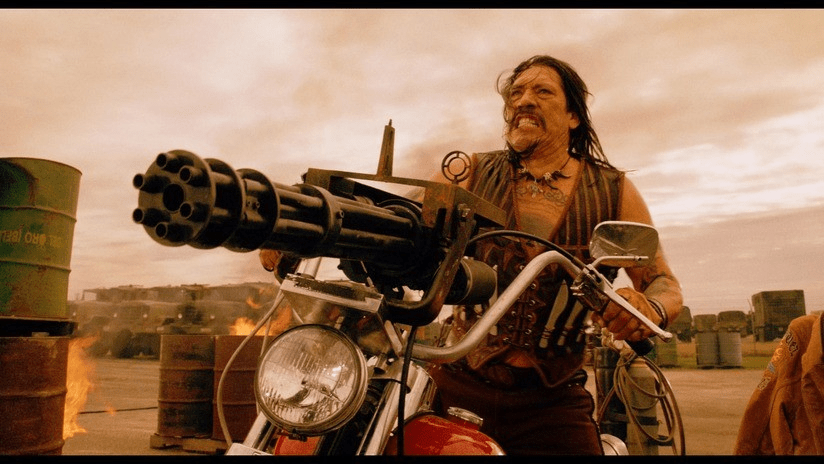
That’s right, Danny Trejo.

So Danny Trejo shows up going full Machete on me, showering the motel in bullets while I run, duck, and dodge behind cover.

^In case you wondered, this is what “going full Machete” looks like.
It’s a fun movie.

Eventually, he runs out of ammo and hops in an old car, trying to run me down. Now my memory gets kind of spotty around this point in the story, but the end point is that I successfully kill him in self-defense. (I think I trick him into crashing the car, or something. Let’s just assume it was something clever.)

That dramatic scene winds up placing me in Witness Protection. I remember they handed me a special form to fill out for, like, my preferences of what kind of Witness Protection I would prefer, and in the special comments section I just wrote “No Italians, please.” Which is several shades of stupid, but made sense in the moment since I was on the run from the Italian mafia.

It doesn’t wind up working.

So Witness Protection places me in a sort of special boarding house that looks like an old Victorian manor out in New England. (Heh, I just noticed the dream keeps taking place in “New” places. New Mexico to New England. Weird.) The boarding house is run by a kindly old woman with red hair and she shows me to my room toward the back of the manor. My paranoia sets in, and on one of the first nights, I remove a couple panels from the floor and I start digging.

The logic at work is that I’m going to construct a series of tunnels to really live in, or at least have as a getaway in case the mob ever finds me. I think I distantly remember reading about or hearing about an either Roman or Chinese emperor who did the same thing with their palace, filling it with a hundred rooms and sleeping in a different one every night to confuse would-be assassins.

Which is basically what I did.

I dug a whole bunch of tunnels into the ground beneath the mansion, and I filled those tunnels with a bunch of dummy routes, dead ends, tunnels that looped back in on themselves. I dug enough dirt to last eleven lifetimes to make sure the mob would never find me.

Along the way, I met another resident of the house, a young girl named Alyssa, who found my series of tunnels and asked to help me dig more because she thought it was cool. At first I said no, wary of outsiders and not wanting to share my masterpiece with another, but ultimately relented.

I also found this awesome, green, furry mole-ferret creature while digging. I never really thought of a name for him, but he was adorable, helped me dig, and loved to snuggle while making this soft purring noise. He was great.

At this point, there’s a bit of a time skip, or a fast-forwarding. I met Alyssa, found my giant ferret creature, at one point we struck ground water and essentially dug out a massive underground grotto or lake. We brought in bamboo from the Overworld (just the regular world, but we’d become underground people) to build scaffolding and walking pathways around this body of water. It was a good time.

But nothing good lasts forever.

One day while I’m hanging out on the big wrap-around porch of the house, I see a car with tinted windows drive slowly by. The window rolls down and a bald man with a scar on his cheek stares me down for a moment, before rolling the window back up and driving away. (No idea why, but I name him Spencer.

My God. I’ve been found.

I have a discussion with the headmaster lady of the house, and she gives me a sort of “Ah, alas. I feared this day would come” sort of monologue, and says she’ll prep the house for battle – or something of the sort. Eventually, it falls to dusk, and a train of twelve cars pulls up in front of the place. Out of each one, a uniquely dressed, themed, and deadly hitman steps out with an intent to kill. They charge the house, and I kung-fu fight with about four or five of them around the house, killing or incapacitating them mightily before I begin to tire and worry for the worse. All around the house, the headmaster lady and other residents are doing their own righteous battle with these (apparently still supposed to be Italian mafia) hitmen.

I’m wounded, and the headmaster lady tells me to fall back, and that they have it from here. So I do, and retreat into my tunnel system. While down there, Alyssa finds me and tells me that our ferret isn’t doing so good, she thinks he’s sick. So I pick up the little guy, he purrs against my chest and neck while I carry him down one of the tunnels, across our underground lake (taking up the bamboo walkways behind us), and into the deepest tunnel that is my Sanctuary. For extra security, I lay a couple of satchel charges in the dirt (which I apparently have) and lie in wait with my ferret creature.

The End

I woke up at that point, but I assume that Spencer the Hitman followed my trail down the tunnels and would have fallen upon me and my ferret, but got blown up by my booby traps. That’s my head canon and I’m sticking to it.

Anyway, if you’ve stuck with it this far or just skipped down until you saw “The End”, either way: The News!

I’ve stopped announcing these sorts of things with any regularity, both because life is busy and because I’m not sure who’s listening with bated breath on this, my tiny, eensy weensy slice of the internet, but we’ve got another publication in the books! (lol Pun.)

Flame Tree Publishing is coming out with their Gothic Fantasy ‘Alternate History’ anthology early next year and are including a reprint of one of my first ever stories, “The Sixth-Gun Conspiracy Letters”, wherein we learn the tragic, twisted truth behind the cloak-and-dagger game which shadowed the American Civil War and the assassination of President Abraham Lincoln.

It’s an oldie, but a goodie, and I’m extra stoked about this one because Flame Tree is based out of London, UK, which means ya boi has gone international! And I think that’s worth a nod. -cheers- (<– the polite gesture at a dinner party, not a crowd erupting with applause)

Anyhoo, that’s all for now. Thanks for sticking around. Ciao, everybody.

Thoughts on Pain (from a Wizard)

I’ve been binging paperbacks hard this year, and a fair amount of those have been The Dresden Files series. If you’re unfamiliar, it’s a series of novels by Jim Butcher centering around a private investigator in Chicago who’s a wizard. Or it might be more appropriate to say he’s a wizard who works as a private investigator. Either way, it’s great. I had friends recommending the series to me for years until one of them just bought me the first five (there are seventeen so far) and I’ve been cramming them almost constantly ever since.

They’re fun reads.

But you ever have one of those moments with a book that sits you down? That can either mean sits you down on your ass because it took you off your metaphorical feet, or it could mean that it sits you down, puts a hand on your shoulder, and has a talk with you. It’s one of those moments where, for a brief minute, you set aside the story the book is telling you and audibly thank the author by their first name like you’re on that kind of basis with them.

This was one of those.

It was a perspective on life that I realized I’m going to be loosely quoting, paraphrasing, and otherwise referencing in deep talks with others for a while, if not the rest of my days on this earth. And I won’t lie, I had expected something like that to come out of ‘The Art of War,’ or ‘The Book of Five Rings,’ or ‘The Alchemist’ (which is also good), or something. Not necessarily a novel about wizards, zombies, vampires, angels, warlocks, and all the rest.

I’m going to put the excerpt here, in all its glory. It’s out of the ninth book in the series, ‘White Night,’ pg. 307-309 if you nab the edition published by ROC. (I don’t know if there are other “editions,” it just sounded fancier to say that way.)

“The wisdom, maybe, was still in process, as evidenced by her choice of first lovers, but even as an adult, I was hardly in a position to cast stones, as evidenced by my pretty much everything.

What we hadn’t known about, back then, was pain.

Sure, we’d faced some things as children that a lot of kids don’t. Sure, Justin had qualified for his Junior de Sade badge in his teaching methods for dealing with pain. We still hadn’t learned, though, that growing up is all about getting hurt. And then getting over it. You hurt. You recover. You move on. Odds are pretty good you’re just going to get hurt again. But each time, you learn something.

Each time, you come out of it a little stronger, and at some point you realize that there are more flavors of pain than coffee. There’s the little empty pain of leaving something behind – graduating, taking the next step forward, walking out of something familiar and safe into the unknown. There’s the big, whirling pain of life upending all of your plans and expectations. There’s the sharp little pains of failure, and the more obscure aches of successes that didn’t give you what you thought they would. There are the vicious, stabbing pains of hopes being torn up. The sweet little pains of finding others, giving them your love, and taking joy in their life as they grow and learn. There’s the steady pain of empathy that you shrug off so you can stand beside a wounded friend and help them bear their burdens.

And if you’re very, very lucky, there are the very few blazing hot little pains you feel when you realize that you are standing in a moment of utter perfection, an instant of triumph, or happiness, or mirth which at the same time cannot possibly last – and yet will remain with you for life.

Everyone is down on pain, because they forget something important about it: Pain is for the living. Only the dead don’t feel it.

Pain is a part of life. Sometimes it’s a big part, and sometimes it isn’t, but either way, it’s part of the big puzzle, the deep music, the great game. Pain does two things: It teaches you, tells you that you’re alive. Then it passes away and leaves you changed. It leaves you wiser, sometimes. Sometimes it leaves you stronger. Either way, pain leaves its mark, and everything important that will ever happen to you in life is going to involve it in one degree or another.”

God. Damn.

Thanks, Jim.